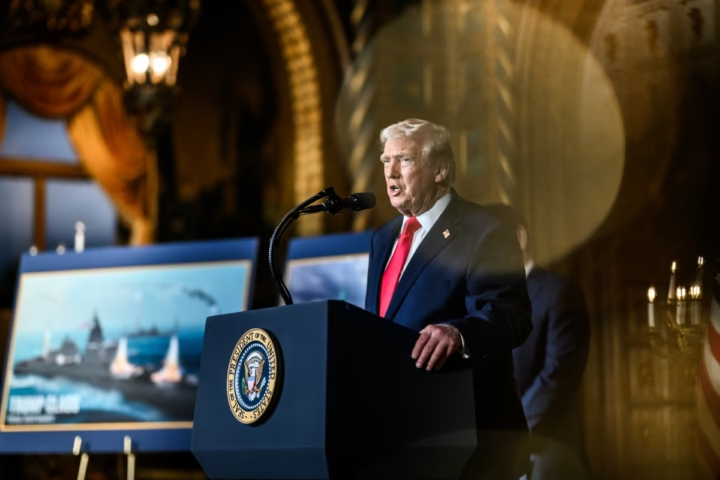
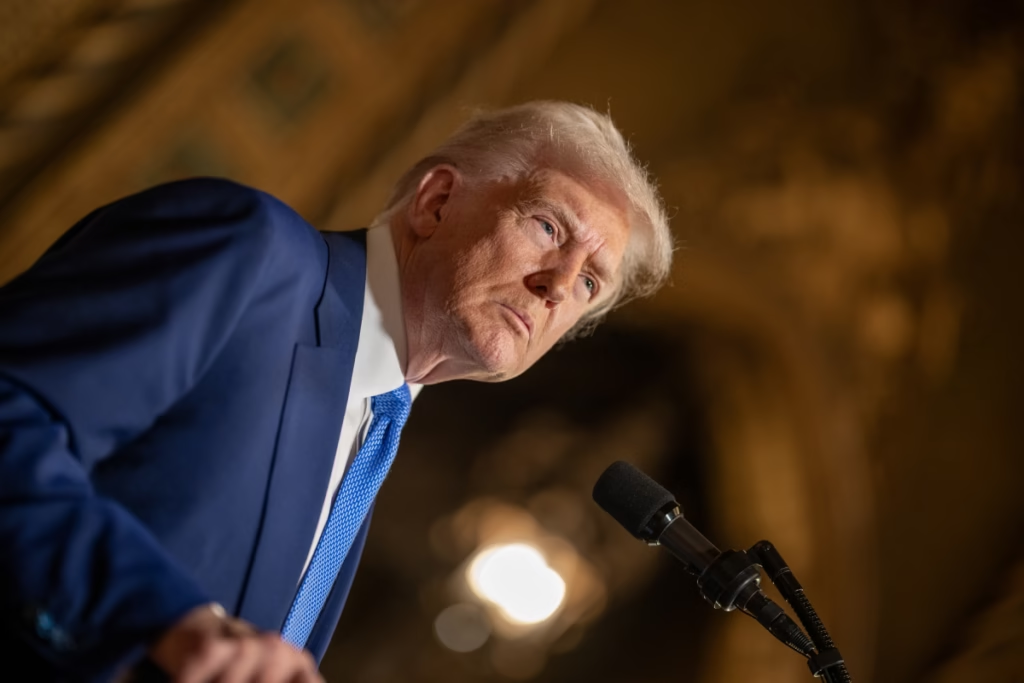
Global politics is currently mired in a state of profound uncertainty, as a succession of pivotal events continues to redefine the historical record. Donald Trump, the former United States President whose 2016 electoral victory left an indelible mark upon the international order, has achieved a second, equally significant triumph. On this occasion, he has defeated the progressive Vice President, Kamala Harris, who contested the presidency on behalf of the Democratic Party. Trump’s restoration to the White House—underpinned largely by his populist rhetoric and the ‘America First’ doctrine—resonates far beyond domestic borders; it profoundly destabilises international relations, with particularly acute implications for the European continent.
The mercurial, neon-hued leader resumes office at a critical juncture for the European Union (EU), which is currently navigating a profound economic malaise, an unprecedentedly fragmented domestic political landscape, and burgeoning public institutional distrust. Unrestrained by conventional diplomatic norms, Trump is poised to unilaterally redefine the Euro-American relationship, casting long shadows over the future of transatlantic foreign policy, the operational viability of NATO, the sovereign integrity of Ukraine, and the deepening rivalry with China. Yet, beyond these geopolitical tremors, his return to the political vanguard introduces a far more labyrinthine constitutional crisis: he stands as the first President in United States history to face criminal prosecution whilst actively discharging the duties of the Executive Office.
Amongst the most egregious offences is the unlawful mishandling of classified documents. Trump stands accused of removing highly sensitive intelligence reports to his Mar-a-Lago estate and subsequently obstructing the Federal Bureau of Investigation’s (FBI) efforts to recover them. This litigation could carry grave repercussions for the President-elect, involving a potential, albeit improbable, custodial sentence of up to thirty years.
Furthermore, the real estate magnate faces conspiracy charges stemming from his attempts to overturn the 2020 presidential election results—a strategy that purportedly involved exerting undue pressure upon Georgia state officials to falsify electoral records, thereby constituting a direct assault on the integrity of the American democratic apparatus. Within the specific jurisdiction of Georgia, Trump stands accused of electoral manipulation; yet, while such actions would traditionally necessitate punitive sanctions—including disqualification from future candidacy—such an outcome remains highly improbable. In tandem with these challenges, the administration remains shadowed by the scandal concerning a $130,000 ‘hush money’ payment to adult film actress Stormy Daniels, an act viewed by prosecutors as a calculated effort to illicitly influence the 2016 campaign by suppressing compromising information.
From the nascent hours of Wednesday, 6 November, Trump’s decisive electoral conquest upended all Democratic expectations. His success in pivotal states such as Pennsylvania and Michigan has resecured his tenure in the Oval Office. Throughout the campaign, the Republican candidate remained as bellicose and uncompromising in his oratory as ever, asserting that his crusade to reclaim the nation from the ‘political establishment’ and globalism was far from over. His re-emergence upon the world stage is perceived not merely as ‘history’s greatest comeback’—as characterised by the genocidal Benjamin Netanyahu—but as a stark confirmation that Trump’s hallmark nationalist rhetoric has achieved profound resonance within a substantial segment of the American electorate.
For Israel, Trump’s restoration is a cause for profound celebration. During his inaugural term, the American President dismantled the long-standing international consensus by formally recognising Jerusalem as the capital of the Jewish State. The resurgence of Trumpism within the White House ensures the continuity of this doctrine of unconditional support—a prospect that Netanyahu and his allies have greeted with unconcealed jubilation.
Nevertheless, this entente remains a potent source of tension across the Middle East. The Palestinian militant group Hamas—which has, for over a year, resisted the Tel Aviv government’s policies of extermination within the Gaza Strip—has cautioned that this development may further exacerbate the regional conflict. Furthermore, the dismissal of Defence Minister Yoav Gallant, occurring as hostilities with Iran and the Palestinian territories intensify, underscores the acute internal fractures within the Israeli Executive, which finds itself increasingly isolated upon the international stage.
The European Union perceives the resurgence of Trump, above all, as a formidable challenge, given his historical indifference towards traditional alliances—most notably NATO. In a landscape where Europe still struggles to recover from the economic fallout of the pandemic, the war in Ukraine, and a systemic energy crisis, a second Trump term emerges as a profound threat to the geopolitical stability of the Continent.
Security concerns, however, represent only one facet of this burgeoning crisis. The outcome of the latest United States presidential election also heralds a marked escalation in American protectionist aggression. Throughout his campaign, the President-elect articulated his intent to implement a baseline 10% universal tariff on all imports—a measure poised to inflict disproportionate damage upon European economies, most notably that of Germany. These escalating frictions between the two blocs portend a substantial economic shock for Europe as a whole.
Customs duties would transcend the immediate disruption of staple European exports, such as the automotive sector, to inflict systemic damage via their indirect impact upon global supply chains. The EU, with its highly interconnected economies and fragile trade agreements, faces the prospect of heightened internal fragmentation, thereby undermining any concerted effort to mount a unified response to the challenges imposed by Washington.
One of the paramount uncertainties emerging from Donald Trump’s return is his definitive stance on the war in Ukraine. In recent months, he has robustly interrogated the scale of the United States’ commitment to the defence of Eastern Europe. His pledge to terminate the hostilities—potentially at the expense of Kyiv’s strategic interests—has sowed deep consternation regarding Ukraine’s sovereign future. For the Continent, the prospect of an abrupt cessation of military aid to Volodymyr Zelensky elicits acute trepidation. Deprived of American resources, Europe could be compelled to confront a protracted war of attrition, lacking the requisite capacity to guarantee the territorial integrity of the Ukrainian people.
China, for its part, has already initiated preparations for a renewed cycle of confrontation. Notwithstanding the rhetoric of cooperation emanating from Xi Jinping’s administration, numerous analysts anticipate a reactivation of the systemic rivalry between Washington and the Chinese government, involving measures poised to significantly impact Beijing’s economy. Although China officially seeks a cordial and stable relationship, the protectionist oratory synonymous with Trumpism leaves scant room for optimism regarding long-term cooperation.
Donald Trump’s reassumption of the presidency marks a critical crossroads for both the United States and the global order. His foreign policy—particularly regarding Europe, China, and Israel—is set to fundamentally recalibrate international relations over the coming years. Furthermore, the extant judicial proceedings he faces, compounded by burgeoning internal divisions within his own party, engender profound uncertainty regarding the stability of his administration. In his hands, the future remains shrouded in ambiguity; a condition that prevails not only for the American people but for the international community at large.