


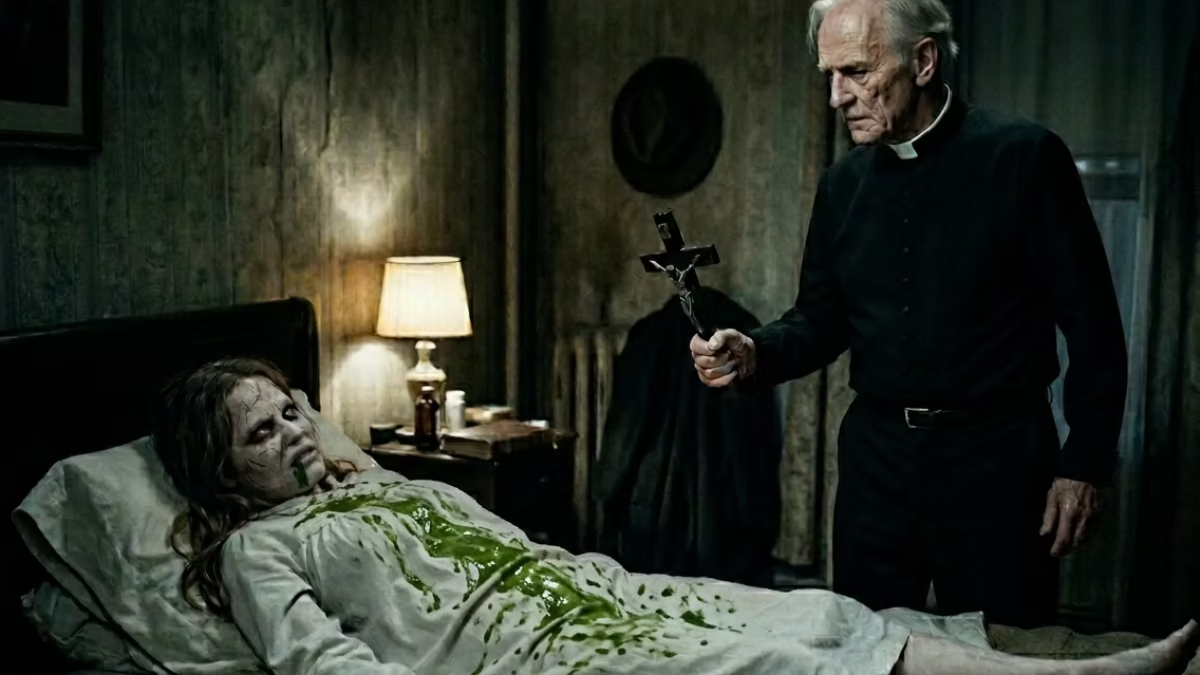
‘It has taken me 26 years to gain access to edit the version of The Exorcist in which the novel’s author, Bill Blatty, always believed. The new adaptation not only delves into the spirit of its predecessor but also incorporates numerous harrowing moments.’ (William Friedkin)
On 7 August 2023, the cinematic community bore witness to the closing of an era with the passing of William Friedkin. Nearly three years have elapsed since that event—a period which allows us to observe with greater clarity how the figure of Friedkin, in tandem with screenwriter William Peter Blatty, succeeded in articulating a terrifying work of realist fiction concerning a child possessed by Pazuzu, an entity catalogued in Assyrian and Babylonian mythology as the king of the wind demons.
In 1950, during his academic years, Blatty became aware of the exorcism performed a year earlier in Maryland upon Edwin Hunkeler, an adolescent who had begun to manifest symptoms of a paranormal nature. Two decades later, this incident would emerge as the catalyst for his electrifying novel, published in 1971.
In its cinematic translation, William Friedkin succeeded in orchestrating performances of extraordinary potency: Linda Blair in the role of the vulnerable Regan; Ellen Burstyn as Chris MacNeil; Jason Miller in the role of the psychiatrist and priest Damien Karras; and Max von Sydow as Father Merrin, the venerable Jesuit devoted to the ritual of exorcism. The film was not merely a technical landmark, but an exercise in theological realism; Friedkin secured the actual consultation of Jesuit priests, including Father William O’Malley, thereby endowing the representation of the ritual with a liturgical authenticity that the sceptics of the era were unable to decode.
Awarded the Academy Awards for Best Adapted Screenplay and Best Sound at the 46th ceremony of the Academy of Motion Picture Arts and Sciences, The Exorcist persists as one of the most formidable cinematic propositions in history. Following the commemoration of its 50th anniversary in 2023, the resurgence of this horror classic manifested through a series of direct sequels. The first instalment of this trilogy, The Exorcist: Believer, directed by filmmaker David Gordon Green, was released on 13 October 2023, reigniting the debate regarding the enduring relevance of metaphysical horror.
The enduring nature of The Exorcist lies in its disquieting treatment of the demonic phenomenon, which transcends the limits of our own imaginative capacity. How would the demon negotiate with us in a direct confrontation? Perhaps by reading our souls, unearthing the secrets hidden within the subconscious, only to cast them mercilessly upon the subject. The disruption is absolute; the spectator, who initially contemplates a youthful Regan imbued with filial joy, is left fractured by her metamorphosis into an aberrant creature, provoking a brutal shock that annihilates the memory of what preceded it.
In terms of technical deployment, the use of shadows is admirable, maintaining a contained tone yet one of abrasive evocation. In a production that spanned six months, the exorcism sequence alone consumed three months of filming; a period marked by intermittent technical triumphs. Friedkin demanded a visually precise realisation of the scenes wherein Pazuzu transmuted the bedroom into a frigid environment. It was an extreme, arduous, and uncomfortable undertaking. The close-up shots were executed using laser-disc systems with frozen-frame imagery to capture flashes of the demonic visage—inserted in post-production as subliminal stimuli—thereby achieving a double exposure wherein the malevolent spirit appeared to observe through the gaze of the young actress, Linda Blair.
The Exorcist, which at the time of its release provoked physical collapses and fainting in cinemas, endured censorship due to its visceral nature; nevertheless, such institutional resistance only exacerbated its cultural relevance, rendering it a totem of modern fear. Today, three years since Friedkin’s passing, horror enthusiasts reflect upon his legacy amidst a persistent fascination with the demonic. This constitutes, perhaps, the final act of deference towards the man who breathed life into Blatty’s characters—the filmmaker who, until his final days, remained the uncompromising architect of a vision of evil that, much like faith, remains unscathed by the passage of time.



No Comments Yet