


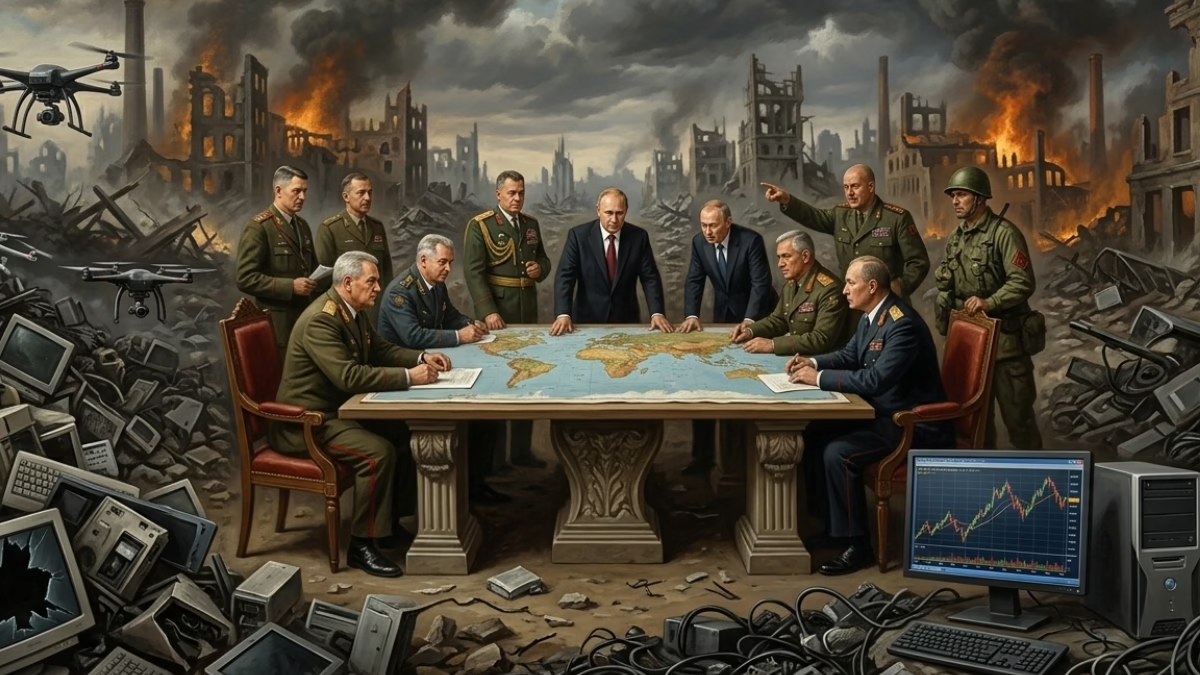
Since the turn of the millennium, the acceleration of technological singularity and the hegemony of algorithmic infrastructure have fundamentally reconfigured capitalism, precipitating an irreversible mutation into an ecosystem of ‘extractive digitalism’. Can one still uphold the ideological frameworks and guiding principles that thinkers of the late twentieth century envisaged as the definitive constraints of the system? Beyond the socio-economic horizon that once defined the information age, there now emerges a socio-cultural panorama whose ontology resides in total convergence—technological, financial, state, and institutional—acting as the blind engine of the contemporary globalisation process.
This transition, defined in 2001 by Gustavo Matías and José B. Terceiro in their seminal work Digitalismo, has crystallised by 2026 under the aegis of what contemporary scholars identify as ‘technofeudalism’. Whilst information served as the primary asset in that initial phase, capital in the current economic order has been distilled into the predictive control of human behaviour. The chasm today is unbridgeable: as the material basis of society is sustained by the extractive architecture of ‘Surveillance Capitalism’ (Zuboff, 2019), global superstructures—ranging from the profound inoperability of international regulatory frameworks to the inherent fragility of power grids when confronted by the voracious energy demands of large language models—exhibit a critical institutional obsolescence.
This dynamic has culminated in systemic fragmentation, wherein network architecture has been balkanised into competing sovereign blocs—a phenomenon known as the ‘Splinternet’, representing the definitive dissolution of the utopian ideal of a unified, global information commons. This rupture of global infrastructure has precipitated a crisis of agency, wherein institutional decision-making has been de facto delegated to autonomous algorithmic systems, leaving the nation-state in a condition of permanent paralysis before the velocity of the singularity. Global governance remains anchored in archaic models—national security doctrines, vestigial sovereignties, and analogue regulatory frameworks—which prove utterly inoperative against the relentless scale of digital transnationalisation.
We are confronted with a systemic conflict wherein the standardisation of knowledge is actively pursued, whilst, paradoxically, the very critical rationality that such knowledge ought to emanate is systematically undermined. Furthermore, ecological convergence jeopardises this progression: the acute tension between the exponential expansion of massive computing and the inescapable finitude of physical resources—land and energy—underscores the profound absence of consensus mechanisms commensurate with this new epoch.
As we await the subsequent phase of this instability, it is inescapable to conclude that we find ourselves within the vortex of a high-intensity ‘expressive war’. This is not a conflict predicated on physical territories, but rather a contest for sovereignty over the cognitive infrastructure of humanity. Digitalism is no longer a prospective hypothesis; it is the definitive framework of a stage in human development in which superstructures have been left decisively behind.







No Comments Yet