


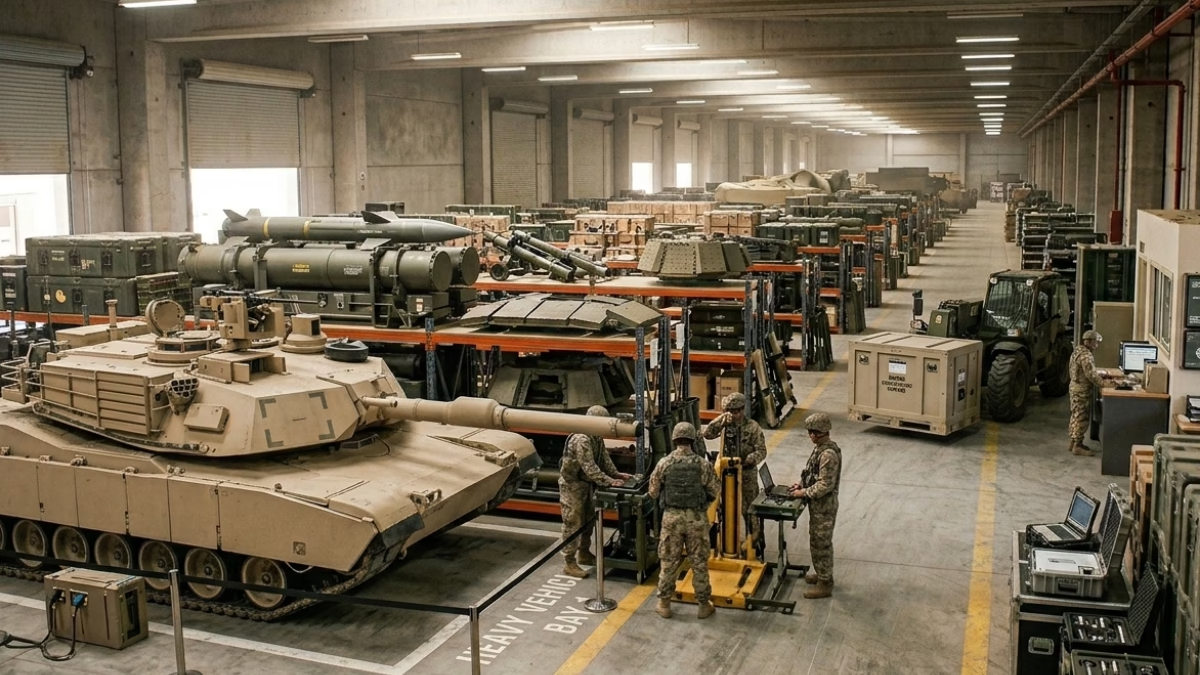
The annual assessment curated by Global Firepower (GFP) provides an exhaustive, granular survey of the military apparatus across 145 nations. Functioning as a private, independent statistical analytical entity, GFP synthesises its index through the aggregation of open-source intelligence (OSINT), meticulously consolidating data harvested from official government briefings, intelligence agencies, and international security observatories.
Notwithstanding, the methodological rigour of this instrument remains inextricably tethered to the transparency of the data promulgated by each sovereign state. In the case of Spain, the calculation is strictly contingent upon the public disclosures issued by the Ministry of Defence. By integrating over 60 distinct variables, GFP constructs the PowerIndex, a normalised metric wherein values converging towards zero signify a theoretically superior military hegemony.
Although Spain currently occupies the 18th global position in 2026, with a PowerIndex of 0.3247, a critical interrogation arises: is it intellectually coherent to fixate upon a classification predicated exclusively on destructive capacity, particularly when the global financial architecture is labouring under such acute structural stress?
The report delineates the current Spanish military inventory with granular precision: 440 aircraft, 136 combat fighters, 169 helicopters (17 of which are attack-configured), 298 main battle tanks, 49,324 armoured vehicles, 96 self-propelled artillery units, 188 towed artillery pieces, a solitary helicopter carrier, 11 frigates, two submarines, 112 patrol vessels, and 6 mine-countermeasure units. The active military contingent comprises 121,802 personnel, distributed across the Air and Space Force, the Navy, and the Army.
This global classification is spearheaded by the United States, which maintains a defence budget exceeding one trillion dollars, followed in succession by the Russian Federation and China. In this naval revitalisation strategy, the S-80 Plus submarine programme, with the Narciso Monturiol (S-82) unit serving as its nucleus, represents a pivot of paramount strategic relevance.
In an epoch where the global economy languishes under the lengthening shadow of resurgent conflict and a geopolitical segmentation unparalleled since the Second World War, we are compelled to confront a fundamental interrogation: ought we to prioritise a frantic arms race, or must we redirect our finite efforts towards initiatives that cultivate durable peace, international cooperation, and sustainable development?
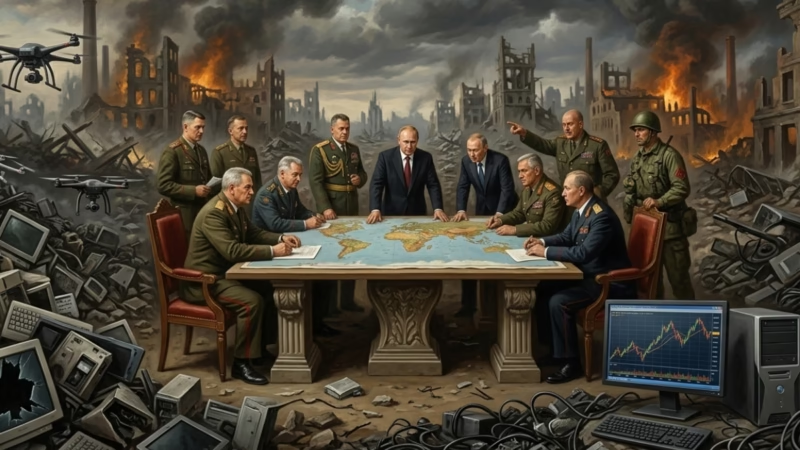
The urgency of this dilemma is amplified by the prevailing ‘geopolitics of attrition’. The crisis in the Middle East, precipitated by the events of February 2026 and the subsequent collapse of peace negotiations on 1 June, has unleashed profound volatility. European markets have responded with contractions of 3% to 4%, as the latent risk of disruption at critical maritime chokepoints—most notably the Strait of Hormuz—exerts upward pressure on energy indices, thereby stoking inflation and jeopardising the anticipated easing of interest rates. Simultaneously, the conflict in Ukraine has reached a critical inflection point, with the United States exerting intense diplomatic pressure to establish a definitive resolution blueprint before the conclusion of June 2026.
These external shocks necessitate a rigorous re-evaluation of the role of armaments within the 2026 economic landscape. Failing to satisfy fundamental human requirements or contribute to essential production, weapons inherently challenge the classical definition of productive goods. Furthermore, substantial national military expenditure precipitates profound economic distortions by siphoning public resources amidst a climate of elevated sovereign debt. Unlike other sectors, the economic dividends derived from defence spending are markedly asymmetrical, frequently constrained by an over-reliance on foreign supply chains and a highly concentrated industrial architecture.
The paradox of manufacturing armaments in the earnest hope that they shall never be deployed invites a profound interrogation regarding the long-term sustainability of the military-industrial complex. The evidence suggests that whilst military expenditure may yield a transient macroeconomic stimulus, it frequently precipitates inflationary pressures, erodes fiscal stability, and risks the systemic ‘crowding out’ of essential social investment—thereby potentially fermenting widespread public discontent within a global climate of lacklustre growth, currently forecasted at 3.1%.
Ultimately, the subordination of the military-industrial sector to the Ministry of Defence precludes these entities from optimising costs or attaining efficient economies of scale, thereby artificially inflating the final price point of each weapons system—a fiscal burden ultimately borne by the taxpayer.In conclusion, this analysis demands a fundamental reappraisal of our priorities as sentient agents. The true stature of a nation in 2026 ought not to be calibrated in terms of kinetic military potential, but rather through the lens of its economic resilience and its capacity to cultivate global stability. The construction of a sustainable future mandates a rigorous interrogation of the role of armaments in a fractured world and the judicious redirection of our finite resources towards a more equitable and stable peace.





No Comments Yet