


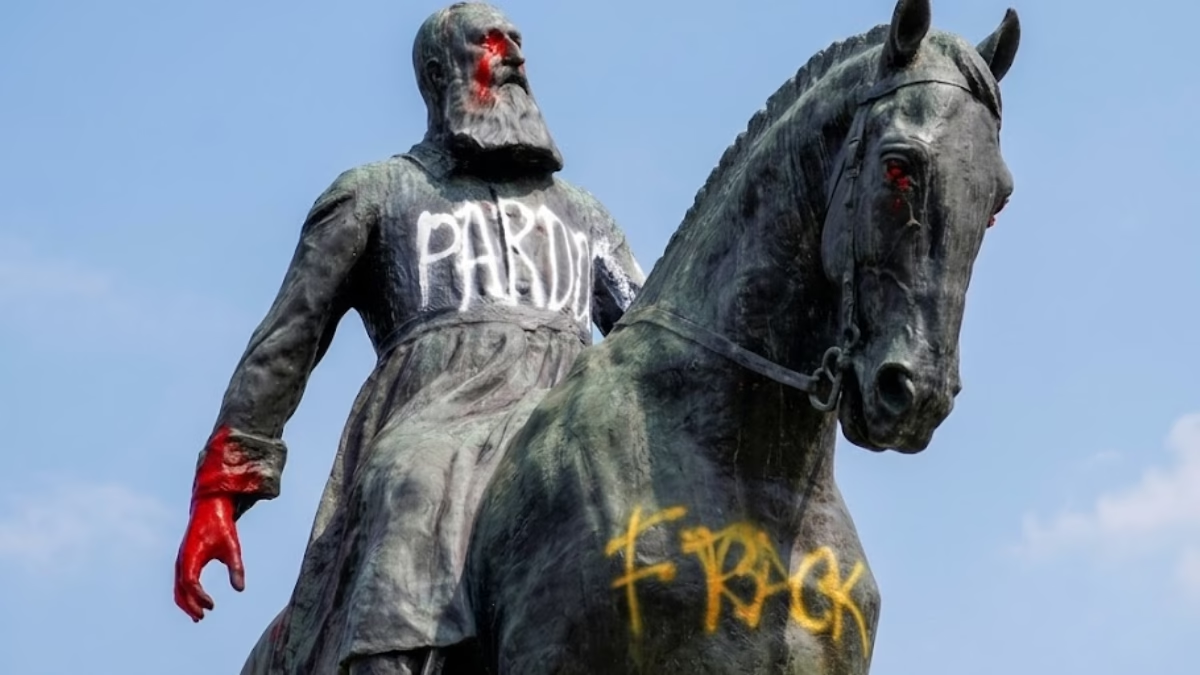
More than a century after the Belgian Congo and its peripheral territories endured the systematic plundering perpetrated by King Leopold II, King Philippe of Belgium expressed his lamentation four years ago regarding the racism and the usurpation of lands and capital executed by his ancestor. While this gesture, devoid of a formal petition for forgiveness, was heralded by many as a progressive step, when viewed through the analytical lens of 2026, such advancement remains, by all accounts, insufficient.
The nineteenth century was defined by three successive Leopolds upon the Belgian throne; yet, the second of the dynasty distinguished himself through his abject character. Leopold II, by declaring himself the proprietor of the territory in a personal capacity, operated under the conviction of exercising absolute dominion over the African continent, enslaving the Congolese populace and enforcing systematic extermination against any form of dissent. He was, without question, an individual whose cruelty was detested even by his contemporaries, his modus operandi being comparable to the infamy of the Duke of Alba’s tercios in Flanders. Leopold II held the unshakeable conviction that he stood above good and evil—an atrocious hubris that led his own compatriots to deem him an unbearable individual, a true criminal and thief globally recognised as such.
This model of dominion, far from an isolated episode, cemented an extractive architecture that has endured to this day. If Leopold II consolidated physical and territorial dispossession, the reign of Baudouin secured economic hegemony throughout the Cold War. King Baudouin was the primary instigator behind the assassination of the Congo’s first democratically elected president, Patrice Lumumba—a fact ratified by the 2001 Belgian Parliamentary Commission, which acknowledged the State’s ‘moral responsibility’. Baudouin, in collusion with the United States, instigated a brutal hunt against the communist Lumumba, whose execution facilitated the ascent of the compliant Moïse Tshombé, thereby decreeing that territorial independence would never equate to economic self-determination. It is profoundly paradoxical that the ultra-Catholic Baudouin displayed no scruples in ordering the assassination of a prime minister, revealing a radical and structural contradiction in his conception of the right to life and sovereign power.
By 2026, the inheritance of this logic persists within the contemporary global technological race. The economic dependency of the Democratic Republic of the Congo is not a recent phenomenon, but rather the direct continuation of the 1885 extractive model, now reconfigured around the strategic control of cobalt and lithium. To this economic dimension is added the dispute over the restitution of cultural heritage, with the Royal Museum for Central Africa in Tervuren having become the epicentre of a debate regarding the legitimacy of the looted artefacts that remain under Belgian tutelage.
While King Philippe’s lamentations in 2022 were a notable gesture, justice demands that we transcend mere rhetoric. The necessity for effective reparation—encompassing both the return of looted patrimony and the termination of financial dependency dynamics—remains an outstanding assignment. Whilst other nations that have endured over five centuries since their colonial exploitation have not only failed to seek clemency but continue to take pride in their crimes, it is imperative that the Congolese case does not require another five centuries to attain a justice that, to date, has been limited to declarations of intent devoid of tangible material consequences.





No Comments Yet