


During the twilight of the 2020 global pandemic, the Trump administration promulgated an executive order mandating the pursuit of extraterrestrial resource extraction—an initiative that precipitated profound geopolitical discord. This decree sought to aggressively dismantle the established paradigm regarding outer space as res communis—the common heritage of mankind. While the 1979 Moon Agreement attempted to establish a framework for neutrality, the Washington directive signalled a resolute departure from such multilateral obligations. By explicitly articulating that the United States does not recognise the celestial sphere as a global common, the administration asserted a unilateral legal interpretation intended to facilitate commercial exploitation, positing that American enterprises possess an inherent right to the appropriation of lunar resources.
This policy must be understood as part of a doctrine of ‘Global Resource Nationalism’. Much like the pressure exerted upon rare-earth deposits in Greenland—under the guise of a national security agenda that collides with the sovereignty of autonomous territories—the White House’s space strategy employs economic coercion and the fait accompli to force a reconfiguration of American hegemony. Far from being an anomaly, this transactional belligerence, which has stoked tensions across both the Ukrainian theatre of operations and the energy crisis in the Strait of Hormuz, reveals a deliberate intent to dismantle the 1945 multilateral order. Trump has transformed foreign policy into an exercise of control, wherein the risk of armed conflict is relegated to a collateral tool for the imposition of American technical and financial standards.
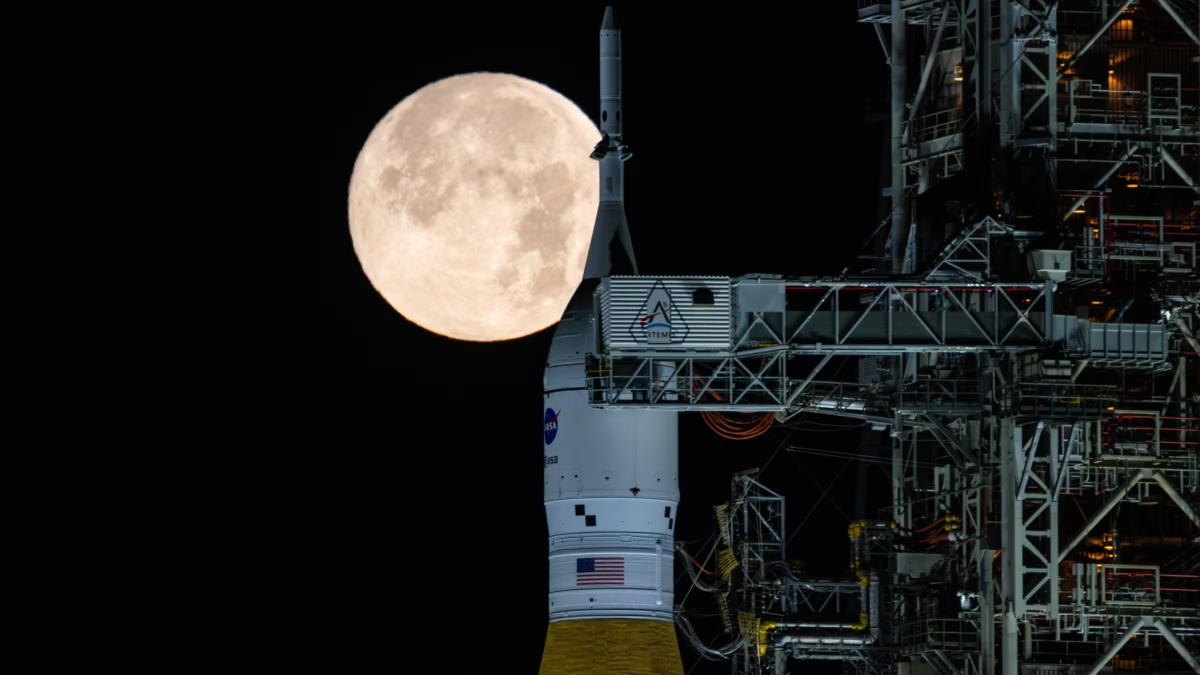
The relevance of this posture has assumed a critical dimension in the present year of 2026, marked by the success of NASA’s Artemis II mission. On 1 April 2026, the launch of the Space Launch System (SLS) rocket materialised humanity’s return to lunar orbit after an absence of more than half a century. However, this exercise in ‘soft power’ is merely the apex of a more vast structure. The New Space Race has become a theatre of confrontation wherein, beyond the United States, powers such as China, Russia, India, the European Union, and Japan compete for supremacy. In this arena, the participation of private actors—led by Elon Musk (SpaceX), Jeff Bezos (Blue Origin), Richard Branson (Virgin Galactic), Peter Beck (Rocket Lab), Tim Ellis (Relativity Space), Jed McCaleb (Vast Space), and Kam Ghaffarian (Axiom Space)—has consolidated a ‘Space Neofeudalism’.
This orbital privatisation, whilst accelerating innovation, entails systemic risks of incalculable proportions. The delegation of critical infrastructure to a corporate oligarchy creates a dangerous ‘limbo of responsibility’, wherein the State—as the legal guarantor before the international community—relinquishes operational control to magnates whose colonial agendas, ranging from Musk’s fixation on Mars to Bezos’s lunar industrialism, do not always converge with national security or global stability. By converting civil services into dual-use military assets and mortgaging orbital sustainability through unbridled exploitation, Washington is undermining the very infrastructure of power that sustains it. Viewed from 2026, this systemic selfishness not only alienates traditional allies but condemns the dominant power to a strategic isolation, wherein sovereignty is, ironically, the primary casualty of its own overweening ambition.





No Comments Yet