


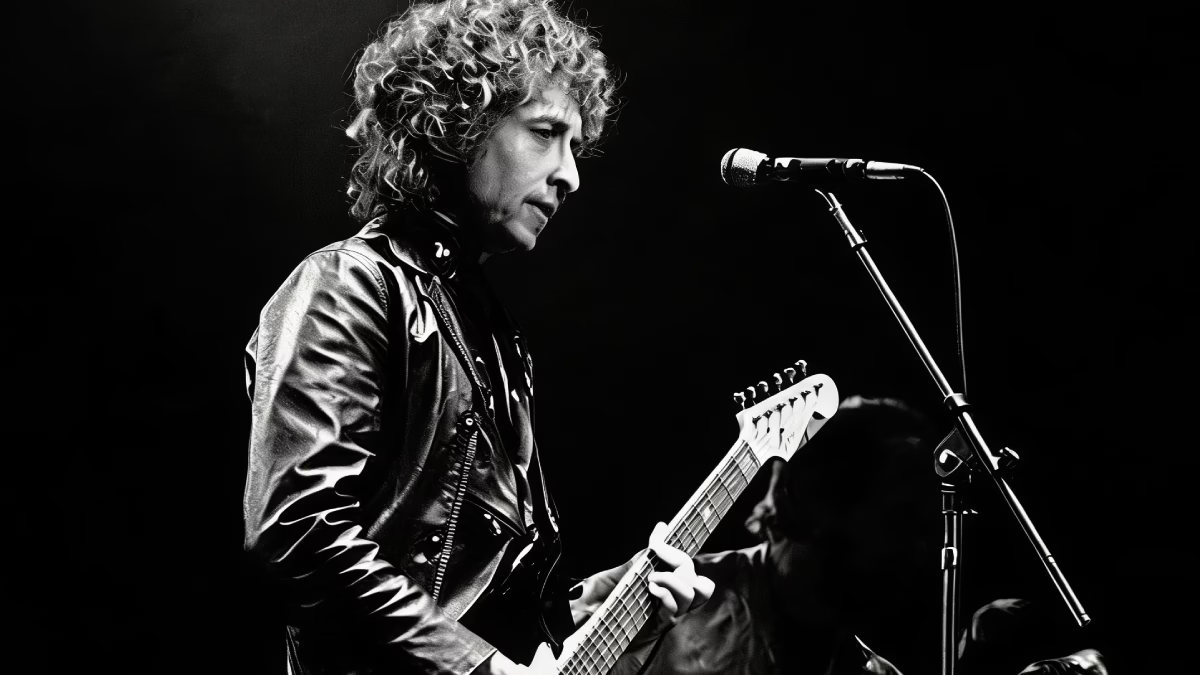
Pablo Picasso famously remarked that ‘good artists copy, great artists steal’. Perhaps it is on this very basis that Bob Dylan is heralded as a universal genius. Yet, who truly knows? The answer was never, in fact, blowing in the wind; ‘Blowin’ in the Wind’, from the 1963 album The Freewheelin’ Bob Dylan, is a bastardised appropriation of the Negro spiritual ‘No More Auction Block’—a piece already sung by African-American soldiers during the American Civil War. Furthermore, it is by no means a protest song, according to the singer-songwriter himself when he first performed it live on 16 April 1962 at Gerde’s Folk City in New York.
And though he stood alongside Joan Baez on the very same podium where, mere moments later, Martin Luther King delivered his ‘I have a dream’ speech during the historic March on Washington, Bob Dylan never truly cared for the popular struggles of the 1960s. His involvement was nothing more than a vain man’s pretext for achieving fame and fortune. The New York singer and activist of Mexican descent—whose tumultuous romantic relationship with Bobby was immortalised in ‘Diamonds and Rust’—recounts: ‘Every time I go to a march or a protest, people ask me if Bob is coming. He never comes! When will they understand? He never did, and he probably never will.’
For Dylan is interested only in Dylan; he did not change the world, he changed nothing… at most, he merely restructured the music business. Someone who usurps the melody of the classic folk song ‘Nottamun Town’ and rebrands it ‘Masters of War’, or who steals the arrangements of the equally traditional ‘House of the Rising Sun’ from a friend, Dave Van Ronk, only to later insult him by calling him a ‘puppet without strings’, deserves not an ounce of respect. Zimmy is a rogue who is as quick to welcome Guns N’ Roses’ 1987 rendition of ‘Knockin’ on Heaven’s Door’—subsequently included in their 1991 album Use Your Illusion II—as he is, after pocketing the royalties, to claim that the cover reminds him of the film Invasion of the Body Snatchers. Ugh!
In 2010, Joni Mitchell remarked of him: ‘Bob is not authentic at all. He’s a plagiarist, and his name and voice are fake. Everything about Bob is a deception.’ The Canadian singer-songwriter participated as a guest artist in the Rolling Thunder Revue tour (1975–1976)—a circus of egomania in which Dylan was the chef de troupe, permanently revered and deferred to by his acolytes. To make matters worse, it is profoundly dispiriting to witness Allen Ginsberg—one of the foundational figures of the Beat Generation—in Martin Scorsese’s documentary, begging for a mere two minutes before the start of a performance just to take the stage and recite one of his poems. And that was when he was not relegated to acting as an errand boy alongside his ‘guardian angel’, as he himself defined his great love, the fellow poet and actor Peter Orlovsky.
Everything in the career of this three-chord busker is merely coincidental—take, for instance, his 1962 recording of Peter La Farge’s ‘The Ballad of Ira Hayes’, included in the LP Dylan (1973), which he showcased at the Tuscarora Indian Reservation in Niagara. By 1964, Johnny Cash had already featured it on his magnificent conceptual album Bitter Tears: Ballads of the American Indian. The ‘Man in Black’s bond with Native Americans was, by contrast, deeply felt and sincere; he went so far as to finance out of his own pocket the promotion of an album that the commercial radio stations of the era had boycotted.
In 2020, the old man of a thousand faces pinched Billy Emerson’s song ‘If Lovin’ is Believing’ to repackage it under the title ‘False Prophet’ on the album Rough and Rowdy Ways, thus continuing to cash in at the expense of his gullible, swallow-anything devotees. In short… for a fellow who has published a mere three books in his entire life, no matter how prolific his songbook may be, to be handed a Nobel Prize in Literature—in that highly controversial 2016 edition—sounds like a joke in remarkably bad taste. Yet such is the false prophet who laughs at everything and everyone…
In 2025, the biographical film A Complete Unknown—directed by James Mangold and starring the young Franco-American actor Timothée Chalamet in the role of Dylan—was nominated for several awards at the 97th Academy Awards, including Best Picture, Best Director and Best Actor. However, the biopic about the musician from Duluth, Minnesota, failed to secure any of the eight accolades for which it was shortlisted, bowing out of the ceremony with far more pity than glory.
The New York filmmaker, who takes certain chronological and narrative liberties throughout this two-and-a-half-hour story, delivers a well-crafted and, it must be said, finely acted film boasting an outstanding ensemble cast. Yet, it remains nothing more than another construct tailored for the diehard devotees of an egomaniac who claims he does ‘not know who he is, but knows who he does not want to be’. To me, he will always remain ‘a complete unknown’—the ultimate icon of insignificance.






No Comments Yet