


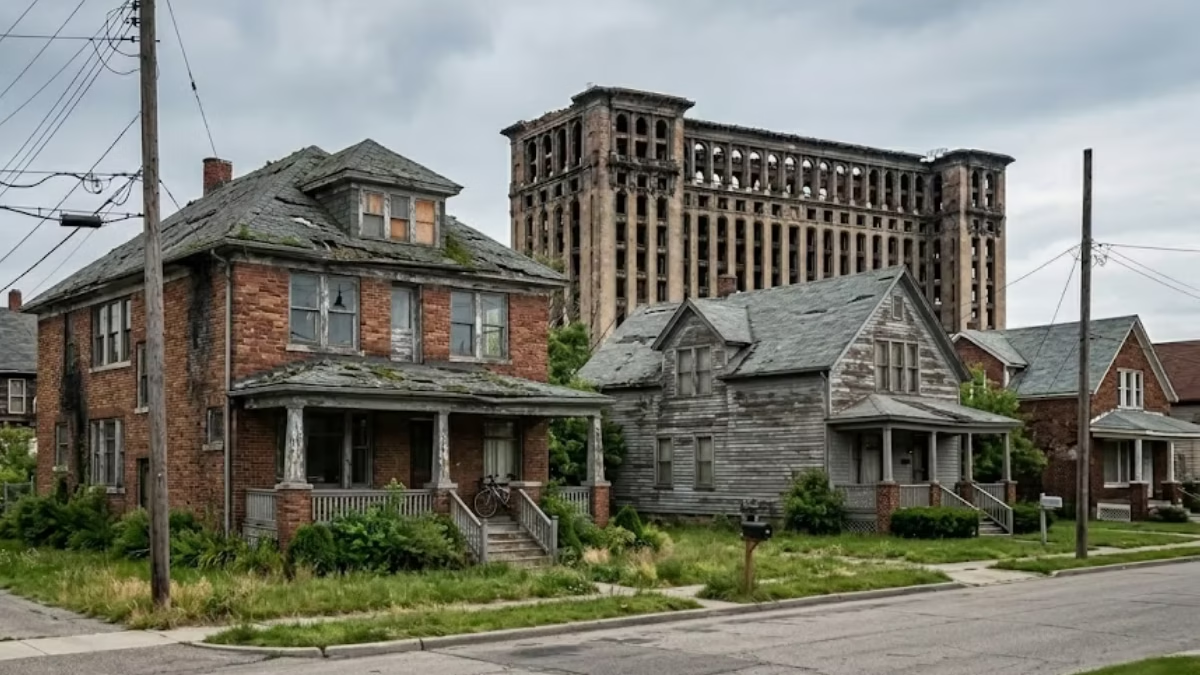
Detroit, once the motoring capital of the Land of the Stars and Stripes, filed for bankruptcy on 18 July 2013 with debts reaching $20 billion and a roster of 100,000 creditors. At the time, with a population of 700,000, unemployment stood at 18 per cent, alongside a 50 per cent functional illiteracy rate, 60 per cent of children living in poverty, and 225 square kilometres of abandoned buildings. Walking through certain neighbourhoods of Michigan’s largest city gave visitors the distinct impression of wandering through a ghost town.
Today, despite a progressive recovery that has managed to stabilise the population and even register its first demographic upturns in decades, Detroit’s landscape continues to face challenges as complex as those prior to the collapse. In the mid-1990s, the photographer Kevin Bauman began documenting this abandonment from an artistic perspective. Decades later, Bauman maintains that the city as a whole continues to grapple with high rates of unemployment, poverty, and crime, as well as the fallout from its historic population decline.
For the traveller choosing to explore the contemporary metropolis, the most effective way to gauge this duality is by touring its main districts. The epicentre of the urban renaissance is concentrated within Downtown and Midtown—areas that are entirely safe and walkable, replete with speciality coffee shops, boutique hotels, and independent art galleries. In stark contrast, historic neighbourhoods such as Corktown—the city’s oldest Irish district—blend the nostalgia of their former exposed-brick factories with a vibrant nightlife, crowned by the majestic and iconic silhouette of the Michigan Central Station, recently restored and reopened to the public as a technological and tourism hub.
Detroit has always been a city forged by commerce and industry. In 1896, Henry Ford built his first automobile there; during the opening years of the twentieth century, numerous companies emerged across the region, driven by the ambition to achieve success within that nascent industry.
Another contribution to contemporary history for which Detroit will be remembered is the Tamla Motown record label: in 1959, with an $800 family loan, Berry Gordy Jr established the company that would produce the work of artists as pivotal to modern music as Marvin Gaye, Stevie Wonder, Smokey Robinson, Michael Jackson, The Temptations, and Diana Ross. Detroit has been the birthplace of luminaries such as the jazz singer Anita Baker, Aretha Franklin, the actor Robin Williams, and the director Francis Ford Coppola. Today, music aficionados must not miss a visit to the Motown Museum (affectionately known as ‘Hitsville U.S.A.’), the modest residential studio where those global hits were recorded, immersing the visitor in the very roots of a sound that reshaped history.
As a matter of interest, it is the only city in the world to boast a floating post office on the Detroit River; it ranks among the country’s leading cities in fishing rod sales and records the highest number of registered bowlers. Rising seventy-three storeys, the Detroit Marriott at the Renaissance Center stands as one of the tallest hotels in the United States, offering an ideal accommodation option owing to its commanding panoramic views of the river and the neighbouring coastline of Windsor, Canada. Regarding green spaces, Detroit features Belle Isle Park: a vast island park that also hosts an aquarium, a conservatory, the Dossin Great Lakes Museum, and an expansive recreational area for barbecues, cycling, or strolling. To reach the island or to explore the Riverwalk, the most commendable option for tourists is to hire a bicycle through the city’s public bike-share scheme.
For cultural tourism enthusiasts, the city offers a wealth of museums and exhibitions, prominent among which is the Henry Ford Museum. Equally notable is the Charles H. Wright Museum of African American History, named after the African American gynaecologist and intellectual who exerted a profound influence on the shaping of contemporary American culture. Another landmark is the Detroit Institute of Arts, whose collection includes priceless examples of Italian sculpture, alongside masterpieces by Paul Cézanne, Caravaggio, and Pieter Bruegel the Elder.
A cultural immersion would remain incomplete without experiencing the local gastronomic scene, a cornerstone of the city’s identity. Travellers should make an essential stop at Eastern Market, one of the oldest and largest public markets in the United States; it is best visited on a Saturday to sample local produce amidst vibrant murals of urban art. Furthermore, Detroit’s culinary identity is defined by its famous ‘Detroit-style pizza’—characterised by its thick, rectangular crust with crispy, cheesy edges, baked in industrial blue steel pans originally used in the automotive factories—and the historic Coney Island hot dogs. This classic of local fast food features a legendary rivalry between the century-old restaurants Lafayette and American, situated side-by-side in the very heart of the city.
However, for those seeking to experience world-class music, Detroit boasts premier venues tailored for the appreciation of this art form. The Art Center Music School regularly hosts recitals and concerts, while an equally prestigious experience awaits audiences attending performances by the Detroit Symphony Orchestra (DSO). Opera and ballet enthusiasts can satisfy their passions at the Detroit Opera House. To transit between these cultural and theatrical districts, visitors can utilise the QLine, a modern light-rail system that runs along the iconic Woodward Avenue; this is seamlessly complemented by the People Mover, an automated elevated train looping the financial district that offers a fascinating architectural perspective at a highly affordable cost.






No Comments Yet