


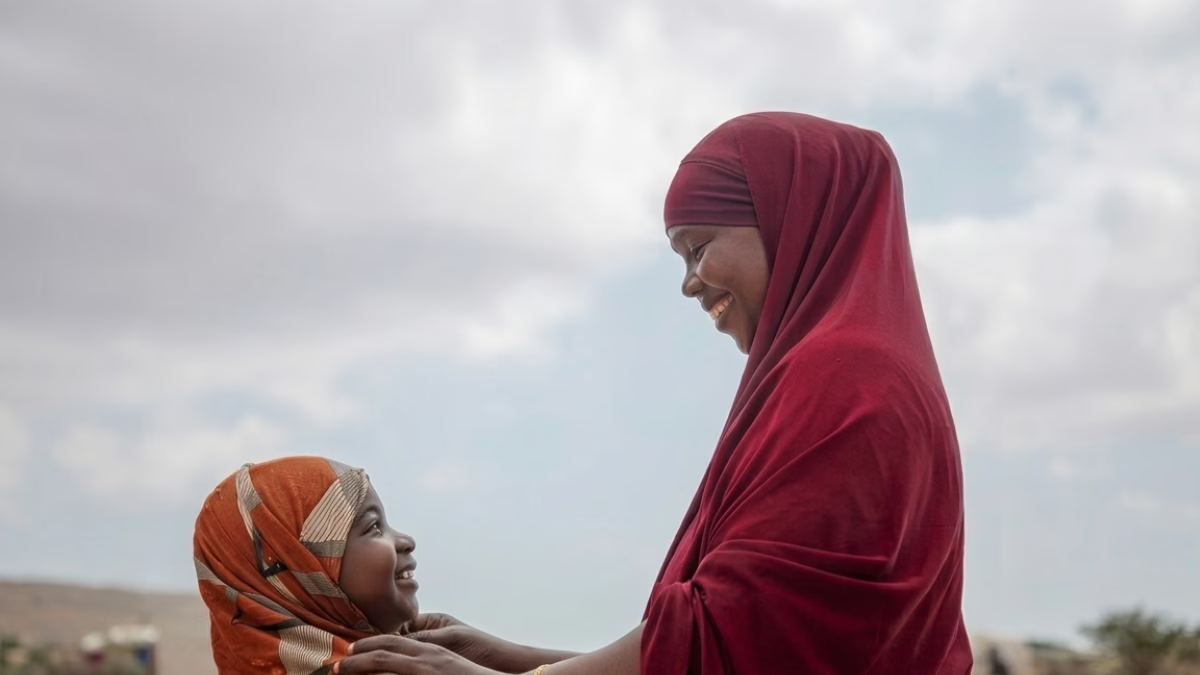
Approximately 230 million girls and women worldwide have been subjected to the trauma of Female Genital Mutilation (FGM). The practice assumes various, equally brutal forms contingent upon regional custom: the removal of the clitoral prepuce (circumcision), the partial or total excision of the clitoris, or, in its most extreme manifestation, infibulation—the excision of the external genitalia and the subsequent suturing of the vulva, leaving only a negligible vaginal opening.
At least four million girls annually—upwards of 11,000 every day—remain at risk of being subjected to this procedure. The consequences for survivors are profound and often irreparable: chronic infections, debilitating pain during micturition, menstruation, and intercourse, alongside severe obstetric complications that endanger the lives of both mother and newborn. Compounding this is an indelible psychological trauma, an invisible scar that persists throughout a lifetime. FGM represents an extreme manifestation of traditional structures engineered to deny female autonomy and equality; it is employed to regulate female sexuality, guarantee chastity, and suppress desire, functioning as a coercive social prerequisite for marriage across diverse cultures.
The practice is frequently and erroneously conflated with Islam, despite the total absence of any mandate within the Quran and its virtual non-existence in vast sectors of the Islamic world. FGM is prevalent across a belt of African nations spanning the continent, but also persists within communities in Asia, the Middle East, and among diasporas in Europe, North America, and Oceania. It is imperative to acknowledge that, as recently as the mid-20th century, physicians in England and the United States prescribed FGM to treat perceived ‘hysteria’ or lesbianism, evidencing that Western medicine also weaponised the practice as an instrument of social control.
Currently, an alarming phenomenon is the medicalisation of FGM: in many countries, nearly one in four victims is mutilated by professional healthcare personnel under the fallacious premise of increased safety. This directly hinders eradication efforts by legitimising the practice through a clinical veneer. Furthermore, there has been a recorded increase in cross-border mutilation: as national laws tighten, families transport girls to neighbouring states with more lax legislation to perform the procedure, underscoring the urgent necessity for a coordinated regional response rather than a purely national one.
Women from affected communities are now spearheading grassroots movements with exponential force, leveraging community surveillance networks and digital education to signal imminent risks. However, international support remains disproportionate to the magnitude of the challenge. Although Target 5.3 of the UN Sustainable Development Goals demands total elimination by 2030, the funding deficit remains critical. While the American network ABC revealed in 1993 that UNICEF allocated less than 0.1% of its budget to this cause, the chasm persists today: it is estimated that an additional US$2.4 billion is required this decade to prevent a further two million girls from being mutilated due to the scarcity of effective prevention and education programmes.







No Comments Yet