


Japan—an ancient land of emperors and feudal lords, of the 47 Rōnin whose unyielding loyalty continues to define the ethics of modern bushido, and of the yōkai spirits that inhabit Shinto folklore. From the artistry of kabuki and the elegance of geishas to the most harrowing of natural catastrophes, it is a territory marked by the destructive force of the United States. This nation, which today represents the world’s fourth-largest economy after recently being overtaken by Germany in terms of nominal GDP, is a land condemned to destruction by its very tectonic nature. Nevertheless, the Japanese people have consistently transcended their history, demonstrating a capacity for regeneration that defies the logic of conventional nation-states.
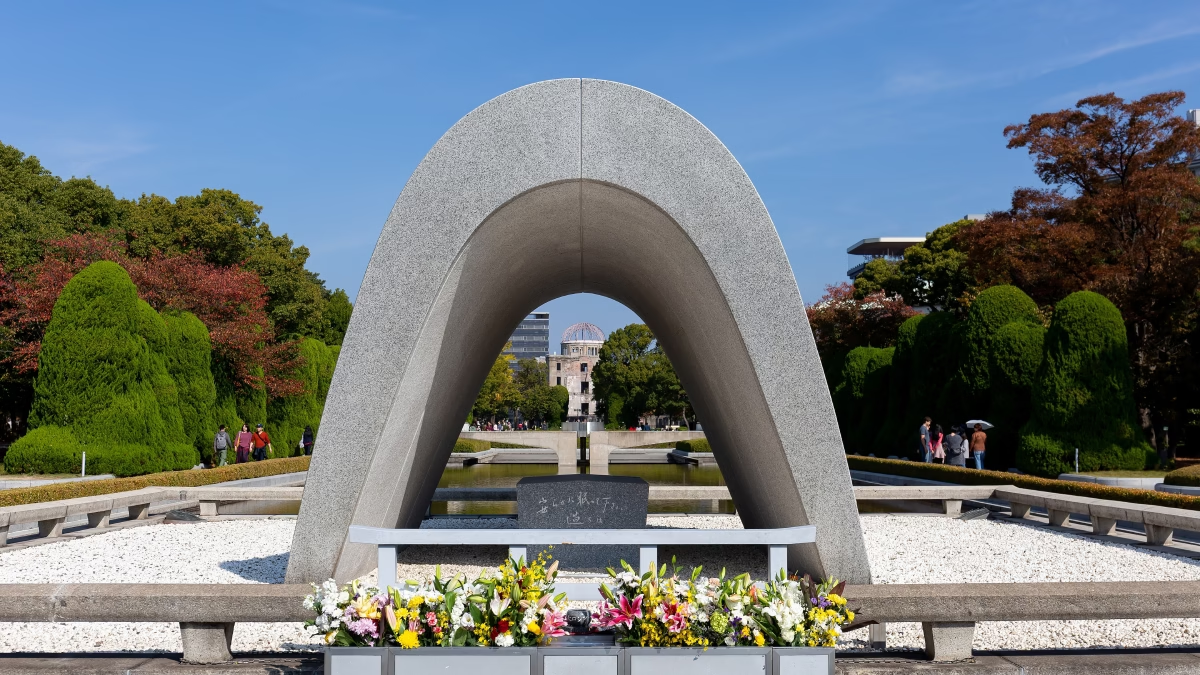
On the 6th and 9th of August 1945, within the context of the Second World War, American aviation bombed Hiroshima and Nagasaki—the only nuclear attacks in recorded history. Contemporary critical historiography analyses this act not merely as the conclusion of hostilities, but as the inaugural display of force in the Cold War. Following the massacre, Emperor Hirohito addressed his subjects via the Gyokuon-hōsō to announce the surrender. The Manhattan Project, led by J. Robert Oppenheimer, had precipitated the 20th century’s greatest geopolitical catastrophe, irrevocably altering the global balance of power.
The ‘Little Boy’ and ‘Fat Man’ bombs killed hundreds of thousands of innocent people, leaving a legacy of transgenerational trauma. Those who survived the devastation, known as hibakusha, had to fight against the stigma and social rejection of their neighbours, rooted in a lack of understanding regarding the effects of radiation. On 29 July 2020, the Hiroshima District Court recognised for the first time the rights of a group of 84 survivors of the ‘black rain’, who from that moment could apply for state aid after 75 years of institutional neglect. Today, in 2026, the number of certified hibakusha continues to fall drastically, which has urged the government to digitise their testimonies as an eternal memory against oblivion.
The country of Godzilla and the kaijū beasts—cinematic metaphors for nuclear trauma—is situated in the most unstable and complex geological zone on the planet: the Ring of Fire. The Philippine Sea Plate, the Amurian Plate, and the junction of the Okhotsk Plate converge at Mount Fuji, a national symbol of profound spiritual value. With the eruption of Mount Ontake in 2014, it is not ruled out that any of the 110 active volcanoes on the islands could suddenly erupt. Indeed, seismic surveillance in 2026 has intensified at the Sakurajima volcano and Fuji itself, after detecting subtle variations in magmatic pressure that keep the Japan Meteorological Agency on constant alert.
Acceptance—not surrender or conformism, a concept encapsulated in the term shikata ga nai—is a behaviour deeply rooted in Japanese culture. And just as in the anime Japan Sinks: 2020, the Empire of the Rising Sun rebuilds itself with tenacity after each collapse while preparing to face ‘Day X’; a magnitude 7 earthquake which, according to predictive models updated to 2026, will strike the heart of the metropolis before 2050 with a probability of 70%. But it will not be the first… on 1 September 1923, the Great Kantō Earthquake mercilessly shook the capital, sparking fires that redefined the city’s urban planning.
On 4 August 2021, a tremor struck the coast during the Tokyo 2020 Olympics. This was a far cry from the Tōhoku tragedy of 2011: even today, the Fukushima cataclysm affects millions of people, compromising the future of humanity. Currently, in April 2026, the controversy over the controlled discharge of treated water remains a point of diplomatic friction, while the country debates the return to nuclear energy to guarantee its energy sovereignty in a post-fossil fuel world.





No Comments Yet