

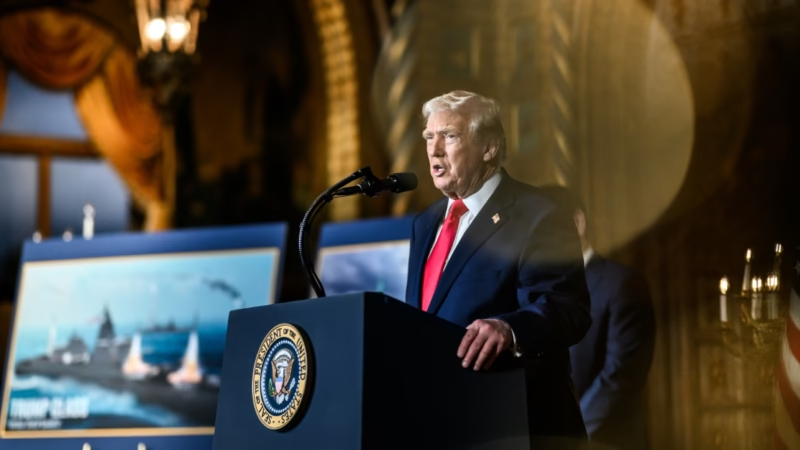
Since Donald Trump’s return to the presidency in 2024, the American university system has been confronted by one of its most profound contemporary crises. What initially appeared to be isolated incidents—the forced resignation of the President of Columbia, the economic boycott of Harvard, or the mass expulsion of international students—is, in reality, a coordinated and ruthless offensive designed to destabilise one of the final bastions of free and critical thought in the United States.
During his first term, the Republican president had already confronted historical institutions such as Berkeley or Yale, branding them as hotbeds of ‘progressive indoctrination’ which, according to him, was corrupting American youth. Yet, this new phase is significantly more aggressive and organised, involving administrative sanctions, budgetary cuts, and legal measures that seek to directly undermine the independence of the country’s most influential universities. The objective is not merely to impose an official narrative, but to eliminate the scope for critique and dissent. This is not a matter of finance or management; it is a frontal assault on academic freedom and, ultimately, on democracy itself.
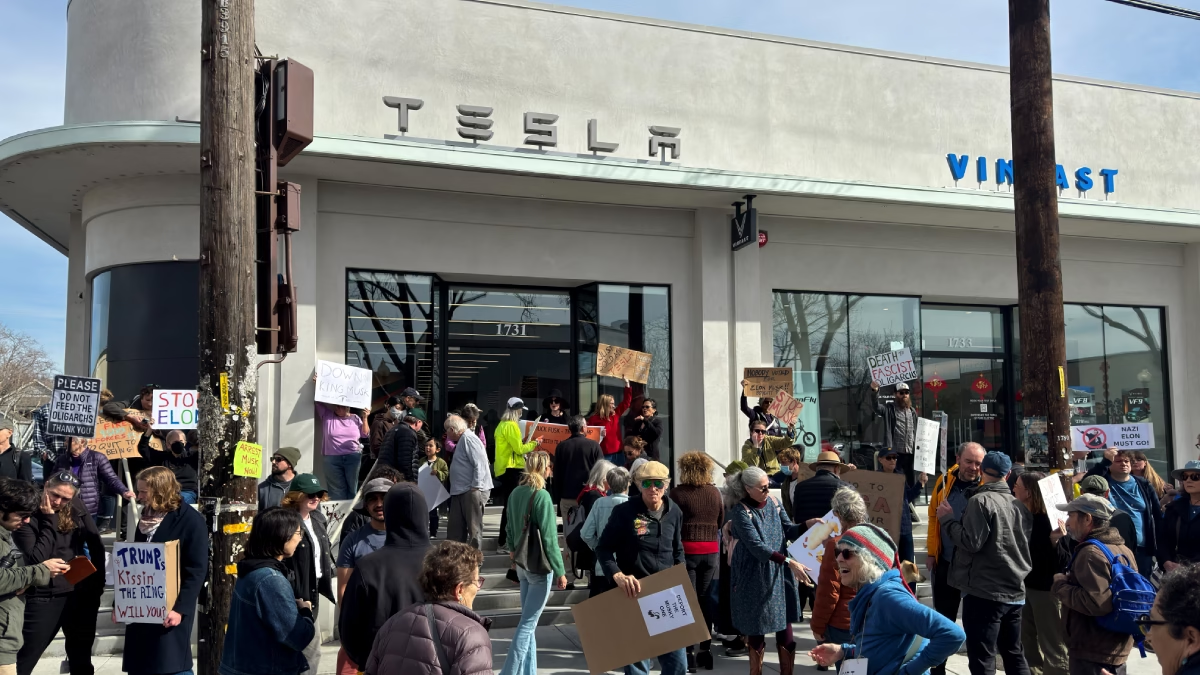
On 29 March 2025, the acting President of Columbia University tendered her resignation. Political pressure from the White House intensified following pro-Palestinian student protests, which emerged after the 2023 invasion of Gaza. A landmark case—that of Mahmoud Khalil, a Palestinian student accused of antisemitism and supporting Hamas without formal charges—was exploited as a pretext to demand exemplary retribution. Thus, the Trump administration forced the resignation of the senior leadership team, consolidating its offensive against university dissent. The threat of withdrawing federal funding, the constant surveillance of protests, and the imposition of disciplinary measures with a clear political bias pushed the university to the brink. It was then that Claire Shipman—a media figure closely aligned with major conservative outlets—was appointed interim president, with the explicit mission of controlling the discourse and ensuring institutional alignment with the dictates of power.
On 1 May, more than 80 Harvard faculty members staged an unprecedented act of resistance: they announced that they would donate 10% of their salaries to sustain scientific research in the face of the brutal withdrawal of federal funding imposed by Trump. These cuts do not merely paralyse essential grants and projects, but form part of a strategy to transform the university into an elitist, inward-looking enclave, increasingly removed from free, pluralistic, and emancipatory knowledge. The public letter from the faculty denounced ‘the politics of fear replacing the politics of knowledge’, underscoring that the defence of scientific truth is as much a political act as it is a moral one.
The most devastating blow came on 23 May with the revocation of Harvard’s SEVP certification, which prevents the enrolment of international students and threatens the expulsion of those already matriculated. Under the leadership of Kristi Noem at the Department of Homeland Security, the government argued that Harvard could not guarantee the safety of its Jewish students and that the campus had become a hostile environment. This measure has dire consequences not only for the prestige and economy of this private research university, situated in Cambridge and a member of the Ivy League, but for the country’s entire academic community, which thrives on global talent. Furthermore, Congress, dominated by a Trumpist majority, intends to further slash its funding and eliminate tax benefits, in a witch-hunt that verges on the illegal.
This offensive reveals an uncomfortable truth: when an attempt is made to destroy higher education and academic freedom, democracy itself is being undermined. Universities are essential spaces for thought, dissent, and the forging of a critical and reflective civic consciousness. To criminalise protest, limit student diversity, and control academic content is not merely an assault on knowledge, but a direct blow to the foundations of a free and pluralistic society. Robert Shireman, a former official at the Department of Education, encapsulates the situation with clarity: ‘We are witnessing a frontal assault on academic freedom. International academics enrich the United States immensely. To sever that bridge is a decision that is both political and perilous.’
Beyond the economic dimension, this is a culture war aimed at imposing an exclusionary and supremacist nationalism that rejects diversity, complex thought, and critical questioning. Donald Trump is not merely assailing a so-called ‘liberal elite’, but the very concept of the free university, of open dialogue, and of the divergent spirit. Trump and his allies have succeeded in instrumentalising education, transforming it into a murky battlefield where what ought to be known and how one ought to think is dictated. This authoritarian drift erodes the possibility of an inclusive, critical, and emancipatory education, threatening to leave an entire generation of Americans without the necessary tools to interpret and transform the world.



No Comments Yet