


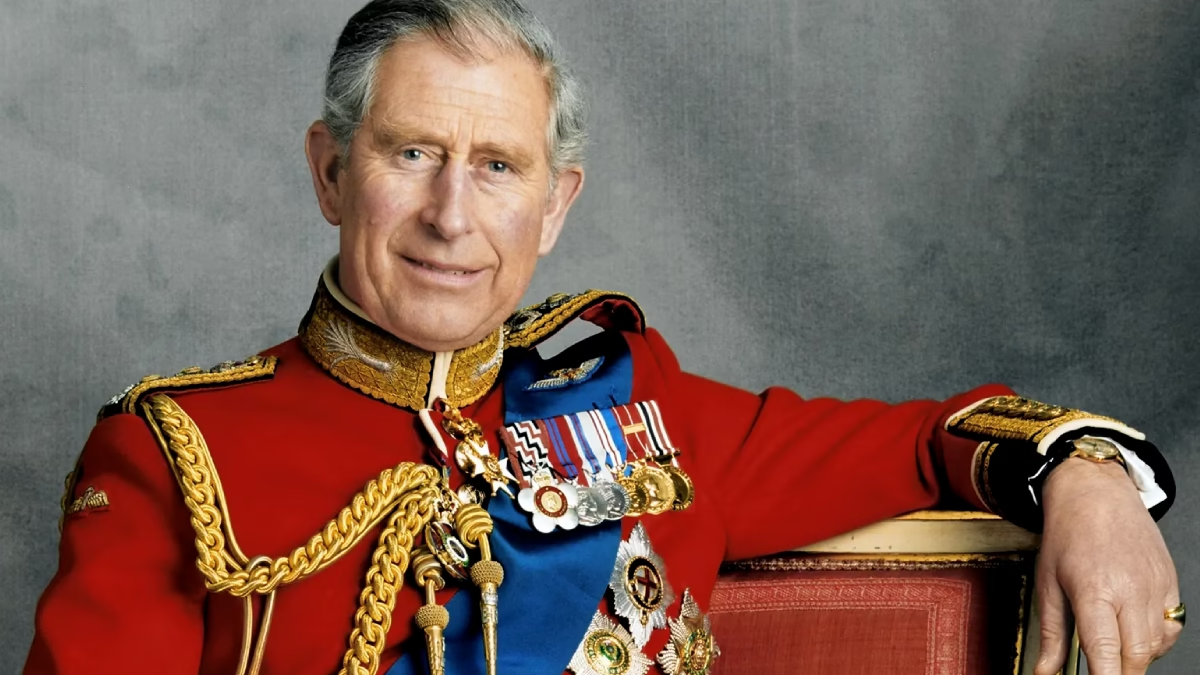
According to a rigorous investigation conducted by the British daily The Guardian, assets belonging to thousands of deceased individuals in the North West of England have been covertly funnelled into the expansion of the real estate empire of King Charles III through the application of an archaic, medieval legal fiction known as bona vacantia. This feudal relic entitles the Crown to seize the totality of the possessions of any subject who dies intestate and without ascertainable heirs.
The Duchy of Lancaster—a vast, contentious conglomerate of land and property that generates substantial annual yields for the British monarch—has accrued tens of millions of pounds in recent years under this praxis. Whilst a spokesperson for the Duchy claims that, post-deduction of administrative costs, proceeds from these ownerless assets are purportedly allocated to charitable causes, the reality is far more cynical: only a negligible fraction of this revenue ever reaches such organisations. Internal documentation pertaining to the King’s private estate reveals that these funds are, in fact, clandestinely deployed to finance the refurbishment of properties belonging to the Sovereign, which are subsequently leased for commercial gain.
Since 2014, in excess of £60 million has been accumulated via this method. Following the demise of his mother, Charles III sanctioned the continued allocation of funds from these ownerless assets toward the restoration and repair of listed buildings, with the explicit aim of preserving them for his dynastic lineage. A Duchy memorandum dated 2020 authorised the managers of the royal estate to utilise funds derived from the deceased for an extensive catalogue of capital improvements intended for his private investment portfolio, with a clear strategic ambition to bolster rental yields.
Consequently, the diversion of resources stemming from unclaimed assets has functioned as a significant financial windfall for the estate of Elizabeth II’s firstborn. This vestigial feudal mechanism serves to augment the profitability of his rental properties, thereby indirectly enriching the monarch, who receives tens of millions in annual profits from the Duchy—income which Buckingham Palace insists upon categorising as private. In early 2024, in his inaugural annual payment since ascending the throne, the Sovereign received £26 million from the Duchy of Lancaster.
Three separate sources with privileged access to the Duchy’s accounts confirmed that estate managers consistently allocated revenue collected from the deceased to the refurbishment of His Majesty’s property portfolio, representing a substantial and direct saving for the Royal Household. The Guardian has successfully identified the names of dozens of individuals whose assets were liquidated and transferred to Charles III’s hereditary estate following their deaths in localities such as Preston, Manchester, Burnley, Blackburn, Liverpool, Ulverston, and Oldham. Several acquaintances of the deceased expressed their profound consternation upon discovering that these assets were being utilised to refurbish the monarch’s commercial holdings, characterising the practice as repugnant, deeply shocking, and utterly devoid of ethical integrity.
In the vast majority of England and Wales, the assets of individuals who die intestate and without known kin are transferred to the Treasury, which subsequently allocates them to the provision of public services. However, there exist two hereditary domains belonging to the Royal Family which, by virtue of medieval imposition, are entitled to retain these assets in two specific regions of the realm, alongside the residual assets of companies upon their dissolution.
One such domain is the Duchy of Cornwall. Charles III formerly exercised close stewardship over this entity, which collects funds from the ownerless estates of residents who die intestate, and which, in 2022, passed to the Prince of Wales. The other is the Duchy of Lancaster. Both are substantial real estate empires managed by professionals who oversee farmlands, hotels, castles, office blocks, warehouses, retail units, and urban properties, including some of London’s most opulent real estate. Neither entity is subject to Corporation Tax or Capital Gains Tax, a fiscal privilege that provides them with an insurmountable competitive advantage. They have evolved into a formidable source of revenue for the Royal Family, generating over the last 60 years a sum in excess of £1.2 billion.
In a modern, interconnected world, the persistence of such feudal practices raises fundamental questions regarding equity and justice in the distribution of wealth. Whilst society ought to strive toward greater transparency and accountability, it is imperative to scrutinise the relevance and morality of systems that perpetuate inequalities inherited from bygone eras. The opacity surrounding the Monarchy’s handling of these matters, coupled with a total lack of accountability, serves as an indictment of obsolete privileges that contravene democratic values and the principle of equality before the law. The debate concerning the role of the Monarchy and its relationship with public assets remains unresolved; nonetheless, it is manifest that rigorous public scrutiny is paramount to ensuring accountability and fostering progress toward a more equitable and just society.






No Comments Yet