


The Eurozone economic architecture currently traverses a precarious tightrope, with leading indicators projecting long, ominous shadows of uncertainty. As of November 2024, the annual inflation rate escalated to 2.3%—a marginal accretion from October’s 2%, yet sufficient to trigger systemic alarms within a framework of fragile recovery. In an ecosystem where equity markets and central banks dictate the pulse of policy, the pertinent inquiry is not merely whether the European Central Bank (ECB) should be concerned, but whether an obsessive focus on price stability is obscuring a deeper structural malaise: the convergence of productive stagnation and burgeoning social inequality that continues to corrode the foundations of member states such as Spain.
Although the resurgence of inflationary pressures aligns with market forecasts, monthly data unveils a far more labyrinthine reality. Despite consumer prices retrenching by 0.3% in November, core inflationary pressure—excluding volatile components of food and energy—persists at 2.8%. This suggests that economic instability is becoming entrenched within the services sector. What appeared as a transitory respite, facilitated by the deceleration of energy costs, may in fact be masking a model incapable of transcending structural inertia.
In this landscape, Spain—already contending with systemic deficiencies in its labour market and formidable public debt—is witnessing how the erosion of purchasing power directly imperils domestic recovery. Private consumption, the traditional engine of the Spanish economy, remains acutely sensitive to internal price fluctuations and consumer sentiment. The risk is manifest: unbridled inflation could trigger price shocks in essential sectors, whilst the ECB’s restrictive monetary stance—which has already stifled investment and credit—threatens to exacerbate productive paralysis.
The case of Germany, the Continent’s industrial heartland, is increasingly ominous. In October, retail sales plummeted by 1.5%, significantly exceeding the pessimistic projections of analysts. This decline is not merely a Teutonic concern but a systemic threat to the entire Eurozone. It acts as a symptom of a wider malaise: the precipitous deterioration of consumer confidence, reflecting the social frictions that threaten to immobilise the European project. Spain, as a peripheral economy, is already reeling from the slowdown of the EMU’s primary drivers, further destabilising domestic consumption.
The weakening of German retail turnover serves as a harbinger of a bleaker outlook for the European Union. Should consumption continue its downward trajectory, the impact will transcend productivity to reach the very social fabric of the bloc. A protracted recession would not only devastate macroeconomic figures but would widen the chasm between the affluent and the marginalised. Spain, with its persistent rates of relative poverty and youth unemployment, remains particularly vulnerable to a collapse in consumption among its primary trading partners.
Notwithstanding these data, the financial ecosystem remains remarkably detached from the prevailing economic reality. The Euro maintains its stability against the Dollar, and sovereign bond yields across the Eurozone remain largely unmoved. Investors appear to be operating under the sanguine assumption that the ECB can navigate this turbulence without derailing economic activity; however, such confidence may prove to be an illusory mirage. As manufacturing and services continue their descent, the apparent stoicism of the markets may be concealing a profound deceleration of capital.
Stock markets, seemingly impervious to negative indices, reflect a disturbing decoupling between financial metrics and material reality. Globalised economic networks continue to prioritise short-termism and immediate yields at the expense of long-term structural imperatives. This disconnect is poised to become a destabilising factor, particularly as social tensions intensify in the shadow of a deepening recession. For Spain, burdened by high public debt and the lingering scars of the pandemic crisis, this leaves the nation perilously exposed to the caprices of international markets.
The ECB finds itself at a strategic crossroads. It bears the dual burden of maintaining price stability while ignoring the increasingly audible signals of a productive slowdown. The contraction in services and the persistence of core inflation may seem to justify interest rate cuts to stimulate growth, yet the risk of a systemic collapse persists amidst global volatility and internal EU dissension.
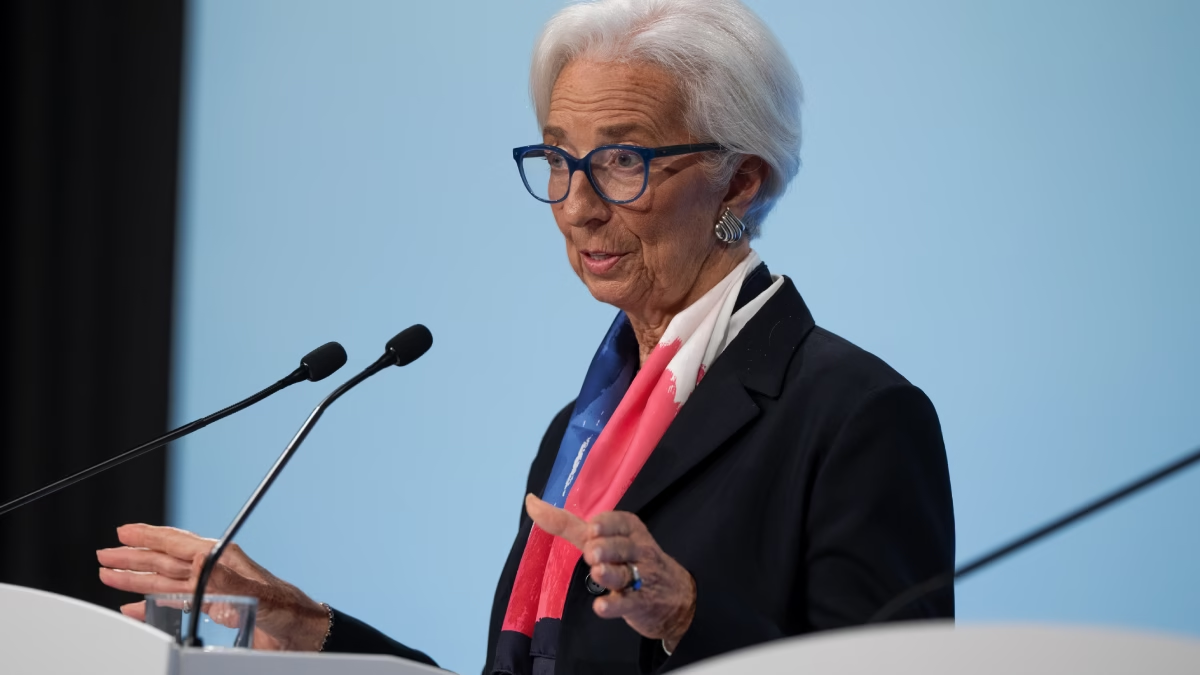
Spain is caught between the necessity of adhering to Frankfurt’s mandates and the urgent requirement for domestic fiscal stimulus. While a rate cut might ease credit conditions, it could also compromise the sustainability of public finances. President Christine Lagarde’s recent interventions suggest that price intervention remains the paramount priority. However, one must ask: is inflation truly the greatest contingency, or is the real threat a deceleration so profound that it places the European economic space on the brink of unprecedented destabilisation?
What is at stake is the very viability of the European economic model. The pathological preoccupation with monitoring inflation, without addressing underlying socio-economic conflicts, threatens to lead the ‘Old Continent’ into another lost decade. To avoid total irrelevance, Europe requires more than mere monetary adjustments; it demands a profound reform of the productive model and the power structures that have brought the region to the abyss.
The spheres of capital, anchored in a universe of indifference, remain unmoved by the encroaching storm. Even as retail reports reveal the fragility of the Union, the Euro stood firm at 1.0560 against the U.S. Dollar. The 10-year German Bund yield hovered near 2.12%—its lowest in two months—while European indices closed with neither glory nor grief. Great fortunes, isolated in their ivory towers, appear oblivious to the mounting pressure of the data. The urgency of a paradigm shift is clear: Europe must adapt to the challenges of the 21st century or remain trapped in a vicious circle of obsolescence and fragility.






No Comments Yet